In today’s fast-evolving digital landscape, businesses need intelligent systems that do more than just store customer data — they must think, predict, automate, and create. That’s where Salesforce’s Einstein GPT comes in — a generative AI innovation that’s transforming how custom Salesforce development works and elevating what organizations can achieve with AI-driven automation and intelligence.
What Is Einstein GPT? A Quick Overview
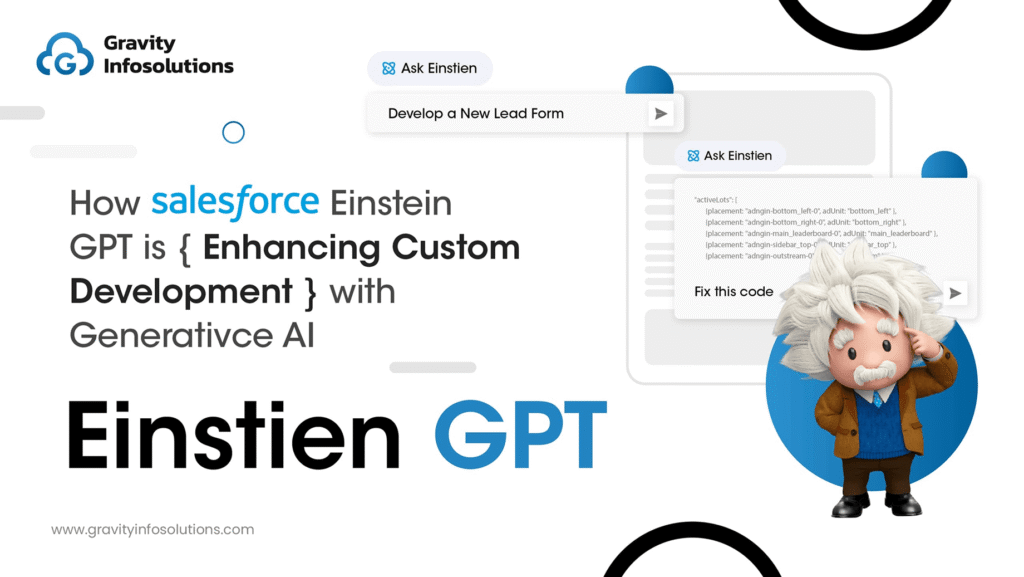
Einstein GPT is Salesforce’s generative AI capability — the world’s first generative AI for CRM — built to combine Salesforce’s trusted customer data with powerful generative models, including partnerships with models like OpenAI’s GPT. It extends native Salesforce AI with real-world, real-time data so that businesses can generate content, insights, and actions automatically.
Unlike traditional AI that predicts or recommends based on historical patterns, Einstein GPT can generate text, code, insights, and responses dynamically, using both CRM data and natural-language prompts from users.
Why Generative AI Matters in Custom Salesforce Development
Salesforce has always supported custom development through tools like Apex, Lightning Web Components, APIs, and platform automation. But with generative AI, developers get a new class of capabilities that significantly streamline development workflows and enable intelligence that was previously manual and resource-intensive. Here’s how Einstein GPT is changing the game:
1. AI-Generated Code and Development Assistance
One of the biggest pain points for Salesforce developers is writing boilerplate code, handling repetitive logic, or debugging complex flows.
Einstein GPT — especially modules like Einstein GPT for Developers — can:
- Suggest code snippets based on contextual prompts
- Generate Apex classes and triggers automatically
- Help with syntax and logic suggestions
- Offer best-practice recommendations while writing code
This means developers spend less time on routine coding and more time on strategy and innovation.
2. Faster Custom Features with Natural-Language Prompts
Traditionally, building a custom Salesforce feature required:
- Gathering requirements
- Designing architecture
- Writing code or configuration
- Testing and refining
With Einstein GPT, teams can use natural-language prompts to generate prototypes or draft features that reflect business logic without heavy manual coding. For example:
“Generate a Lightning Web Component that shows top accounts by annual revenue and highlights priority customers.”
Einstein GPT can interpret such prompts and turn them into actionable code templates or configuration blueprints, helping businesses accelerate delivery timelines.
3. Intelligent Automation Built Into Workflows
Salesforce already enables automation with tools like Flows and Process Builder. But integrating Einstein GPT adds a layer of intelligence:
- Dynamic recommendation engines based on customer history
- Personalized email and message generation
- Auto-classification and routing of records
- Predictive insights embedded into workflows
This means automation is not just rule-based — it becomes context-aware and responsive to business conditions.
4. Seamless Integration of Third-Party AI Models
Einstein GPT isn’t locked into a single AI engine. Salesforce’s platform supports an “open ecosystem” where developers can Bring Your Own Model (BYOM) — integrating models like Anthropic’s Claude or advanced versions of OpenAI’s GPT — directly into Salesforce custom apps. This flexibility allows organizations to:
- Select AI models that best fit their use cases
- Maintain control of sensitive data
- Build AI-enhanced applications that serve different departments (sales, service, marketing)
5. Enhanced Personalization and Customer-Centric Experiences
For customer-facing development — such as building self-service portals or custom messaging systems — Einstein GPT helps generate:
- Personalized responses for customer queries
- Tailored emails based on recent interactions
- Recommendations driven by unified CRM data
This turns custom feature development into an intelligent experience-centric journey, delivering more value than static interaction logic.
What This Means for Business and IT Teams
Einstein GPT isn’t just a developer tool — it’s a collaboration engine.
For Developers
- Reduced time for writing and debugging code
- AI support for complex logic design
- Enhanced capability to build smarter apps
For Business Leaders
- Faster time-to-value for Salesforce customizations
- Lower development costs with automated capabilities
- Greater alignment between tech deliverables and business outcomes
Real-World Use Cases in Custom Development
Here are practical examples where Einstein GPT is enhancing Salesforce custom development:
🧠 Intelligent Lead Assignment
AI evaluates customer data and dynamically assigns leads to the best-fit sales rep based on historical performance and likelihood to convert.
📧 Automated Proposal Generation
Einstein GPT can generate custom sales proposals with recommended products and pricing, based on customer history and engagement trends.
📊 AI-Driven Dashboards
Generate dashboard configurations and insights automatically from natural-language prompts — speeding up analytics and reporting workflows.
Future Trends and What’s Next
The fusion of generative AI with CRM platforms like Salesforce sets the stage for even more advanced capabilities:
- AI-driven agents that act autonomously
- Predictive forecasting built into custom apps
- Conversational interfaces embedded into Salesforce screens
This is not AI for its own sake — it’s about making Salesforce custom development more intelligent, more efficient, and more aligned with business goals.
Conclusion: A New Era for Salesforce Custom Development
Salesforce’s Einstein GPT isn’t just another feature — it’s a transformative leap in how generative AI is integrated directly into the CRM platform to empower both developers and business users. By automating routine tasks, enhancing feature creation, and leveraging AI models grounded in real-time customer data, Einstein GPT is redefining what’s possible in Salesforce custom development.
Whether you’re building internal tools, customer portals, or complex workflows — incorporating generative AI accelerates development and unlocks deeper value from your Salesforce investment.